
Izard County Court Records After Arrest
After an Izard County jail arrest, the public should not treat the booking entry as the final court record. The sheriff roster from Sheriff Charley Melton's office shows booking charges as they existed in custody. The profile itself warns that charges and bail amounts may change after court appearances and may not be current. Court records after an arrest are the next source to check because they show filed charges, case events, charge status, judgments, and future hearings when those items are public.
The criminal case path is straightforward in concept: arrest, booking, first appearance or bond review, prosecutor review, charging document, court case, court events, and disposition. The 16th Judicial District Prosecuting Attorney decides what formal charges to file or amend for Izard County cases. Courts enter dispositions and judgments. The prosecutor does not convict a person, and a jail charge is not a conviction.
For custody details, use Izard County jail inmate records. For booking photos, use Izard County jail roster mugshots. The sheriff's administration page also describes records maintenance, court coordination, and criminal case files. Court records after a jail arrest answer a different question: what did the court and prosecutor do with the arrest once the case moved beyond intake?
Find Izard County Court Records
Search ARCourts is the official Arkansas Judiciary public case-search portal. The Judiciary's Search ARCourts information page says the portal replaced Public CourtConnect and can provide public case information by person name or case number. It may show parties, judge, filings, charges and dispositions, future events, judgments, and document links for some public court records.
- Start with the roster profile only to confirm spelling, booking date, charge wording, and any booking number.
- Open Search ARCourts and search by defendant name or case number if known.
- Use court or county filters when the name is common or several results appear.
- Open the case and compare filed charges with the jail's booking charge text.
- Review future events and dispositions, but do not treat a pending charge as a conviction.
- If the case is missing online, contact the filing court or clerk because AOC support does not answer case-specific questions.
The Arkansas Judiciary page also says some case information is not public online under Arkansas Supreme Court Administrative Order 19. That means a missing online item is not proof that no case exists. It may be sealed, restricted, not yet indexed, filed in a different court, or available only through the court clerk.
The Search ARCourts portal screenshot shows the statewide public case-search entry point used for Arkansas court records after a jail arrest.
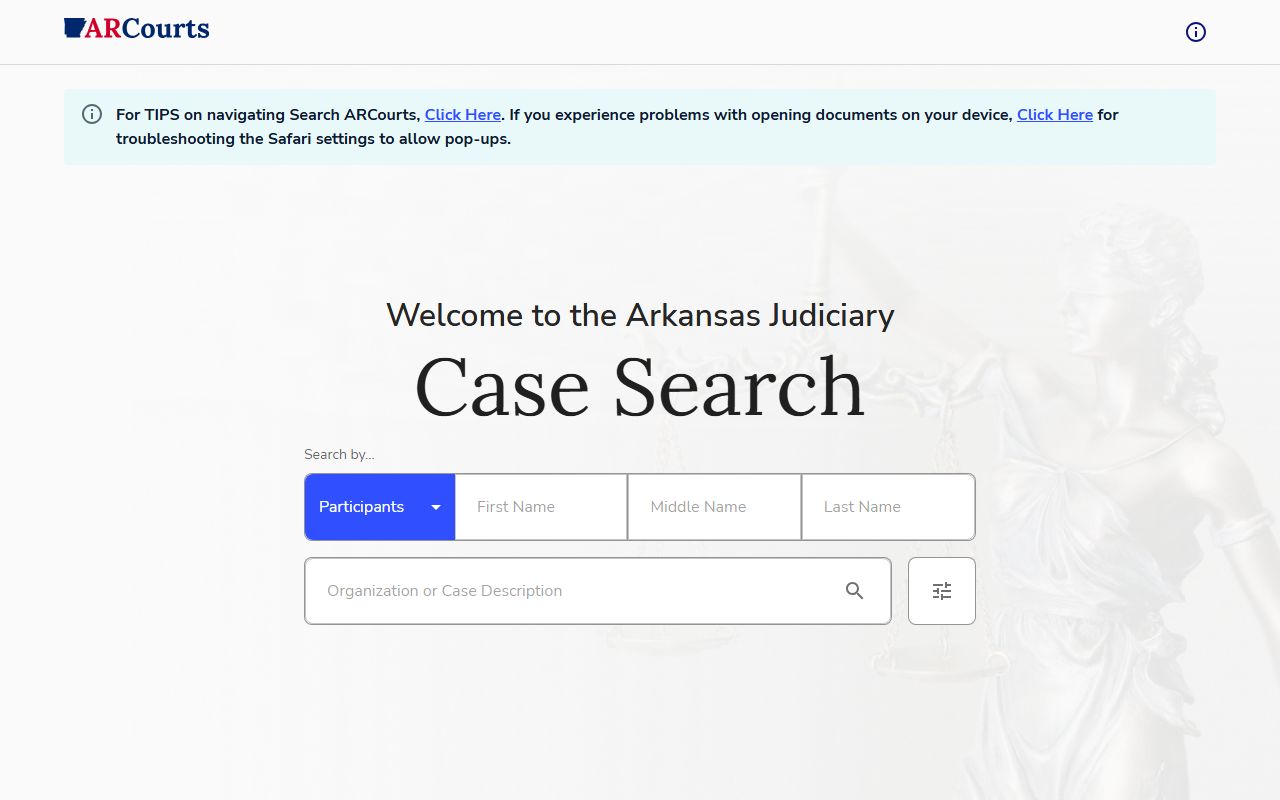
The portal is statewide, so Izard County searches may need careful filtering by name, county, court, charge context, and case date.
The Arkansas Judiciary Search ARCourts information page documents what public case information may appear in the portal and where online access is limited.
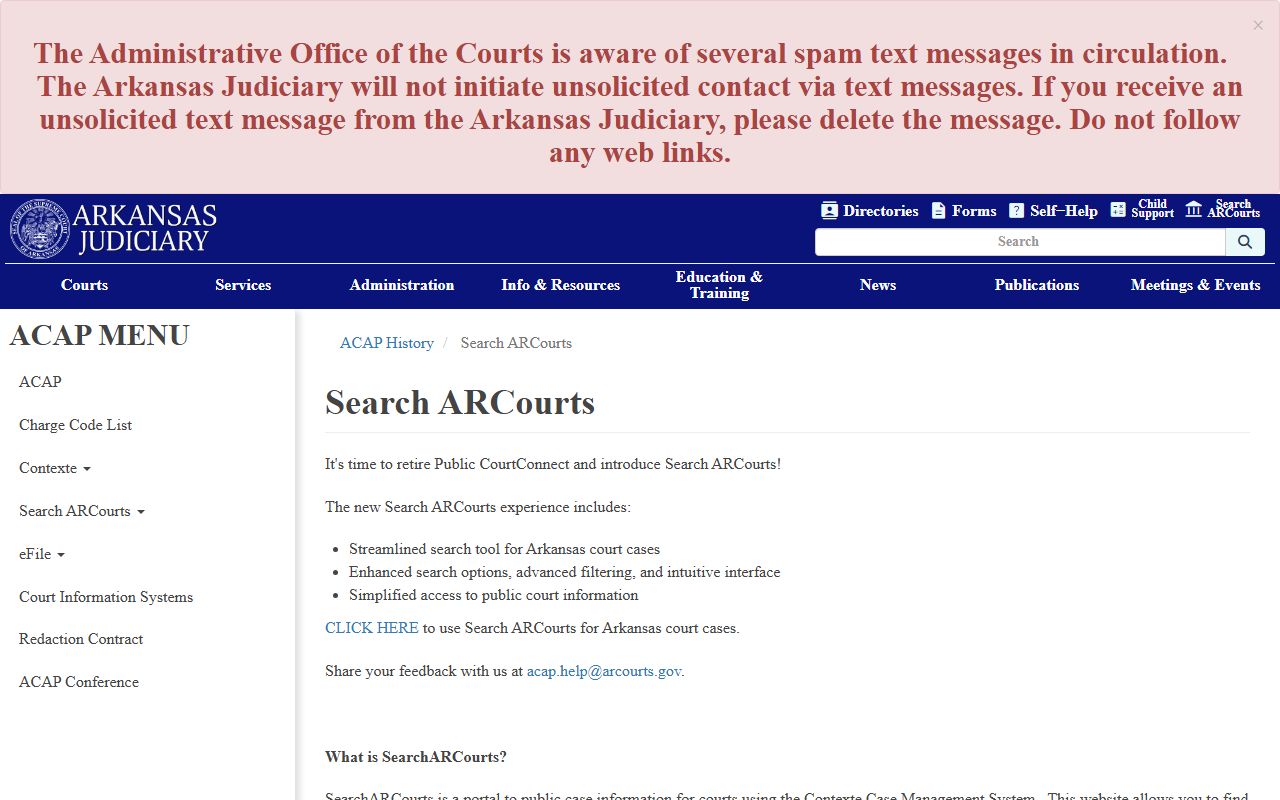
That source is important because it explains the public case fields and the Administrative Order 19 limits that can keep some records offline.
Izard County Court Search Fields
The court portal is not the same system as the sheriff roster. It is case-centered, while the roster is booking-centered. A person may appear in both places, but the fields and timing differ. The roster can help with spelling and initial charge language, but Search ARCourts is the correct public portal for formal court records after a jail arrest.
| Field Label | Type | Required | Options / Format Notes |
|---|---|---|---|
| Person/name search | Text | Unspecified | Judiciary guidance says public records can be found by a person's name in the case. |
| Case number | Text | Unspecified | Use when the court case number is known from court papers or clerk contact. |
| Court/county filters | Filter | Unspecified | Advanced filtering helps separate Izard County cases from other Arkansas cases. |
| Search/submit | Button | Yes to execute search | Runs the public portal search. |
For portal help, the Judiciary page lists AOC support at (501) 410-1900 option 1 and (866) 823-5778. For a specific case, contact the court where the case is filed. The sheriff administration page says misdemeanor fines and tickets should route to the District Court office at 870-368-4390, which is useful when the arrest grew out of a district case, fine, or failure-to-appear warrant.
Charging Records After Jail Arrest
Izard County court records after arrest usually turn on the charging document. A booking charge is the allegation listed at intake. Prosecutor review may lead to the same charge, a changed charge, more counts, fewer counts, or no filed charge. Arkansas uses prosecuting attorneys by judicial district, and Izard County is served by the 16th Judicial District Prosecuting Attorney.
| Charging Document | Who Uses It | What It Does | Izard County Search Note |
|---|---|---|---|
| Complaint | Law enforcement or prosecution path | Starts or supports a criminal case with alleged facts or charges. | May be tied to district or early case events. |
| Information | Prosecuting Attorney | Formal prosecutor-filed charge document, common in felony practice. | Look for filed charges and later amendments in court records. |
| Indictment | Grand jury | Formal charge returned by grand jury process. | Less common than prosecutor information, but still a charging route. |
The official prosecutor page for the 16th Judicial District identifies Drew Smith as Prosecuting Attorney, with the office at 368 E. Main St., Batesville, AR 72501, phone 870-793-8825, and mailing address P.O. Box 4050, Batesville, AR 72503. The office covers Cleburne, Fulton, Independence, Izard, and Stone counties, so it should not be described as an Izard-only prosecutor's office.
Izard County Charge Status Records
Charge status is the key reason to search court records after a jail arrest. The jail roster may list a charge description such as theft, failure to appear, petition to revoke, parole hold, or hold for ADC. Court records show whether a charge is still pending, amended, reduced, dismissed, or resolved. The difference can matter for bond, future court dates, probation issues, and whether the record may later qualify for sealing.
| Status | What It Means | How to Read It |
|---|---|---|
| Pending | The charge has not reached final disposition. | Check future events and do not call it a conviction. |
| Amended | The filed charge or allegation changed. | Compare the roster charge to the latest court filing. |
| Reduced | A lesser charge replaces or resolves a more serious count. | Read the final judgment or disposition, not only the original count. |
| Dismissed | The court or prosecutor ended the charge without conviction on that count. | Other counts may still remain active. |
| Nolle prosequi | The prosecutor declines to proceed on that charge. | It is a prosecutor action, not a guilty finding. |
| Judgment | The court enters final order, sentence, fine, probation, or disposition. | Use this before describing a final outcome. |
Important: A public roster entry is not a certified court disposition. Use the filing court for certified records and final case status.
Bond Records After Arrest
Bond is where jail and court records overlap. The roster may show a dollar bond, omit a bond field, or include a charge or hold that explains why release may not be simple. Examples observed in Izard County research included dollar bonds, hold for other agency, hold for ADC, parole hold, failure to appear, contempt, and petition to revoke. The profile warning is direct: charges and bail may change after court appearances, and persons posting bail should call 870-368-4203 for current bail, charges, and case numbers.
| Bond / Hold Term | Practical Meaning |
|---|---|
| Cash bond | Full ordered amount is paid when allowed by court or jail procedure. |
| Surety bond | A licensed bail bond company posts bond when allowed. |
| Personal recognizance | Release based on a written promise to appear, without upfront cash. |
| Hold for other agency | Another agency may control release even if a local bond appears. |
| Hold for ADC or parole | State custody or supervision authority may prevent ordinary release. |
| No-bond hold | A court or legal status blocks release by bond. |
No official source reviewed published Izard County bond payment methods, lobby bond hours, accepted instruments, or online bond payment rules. Do not assume credit cards, cashier's checks, property bonds, or 24-hour cashier access. Verify with jail staff and the court before trying to post bond.
Warrants and Court Records
Warrants often explain why a jail arrest has an active court-record trail. The sheriff website has a Most Wanted section behind an official disclaimer, and weekly incarceration reports often list arrests on Izard County District Court failure-to-appear warrants. No separate official active-warrant search form was located. Current roster entries may also show failure to appear, contempt of court, parole hold, hold for ADC, or hold for another agency.
Records language should stay practical. A bench warrant is usually issued by a judge, often after failure to appear or contempt. A fugitive or hold entry may mean another jurisdiction seeks custody. A search warrant authorizes a search and does not always mean custody. For records checks, use Search ARCourts, the roster if the person is in custody, the District Court number for misdemeanor fine or ticket routing, and the sheriff phone line for custody status.
Charge Versus Conviction Records
A charge is an allegation. A conviction is a final adjudication of guilt through a plea, verdict, or other court disposition that carries the legal effect of conviction. Court records after a jail arrest may contain both charged counts and final outcomes, but the terms should not be blended. The sheriff's incarceration reports also preserve this distinction by saying listed people are presumed innocent until proven guilty in court.
| Record Type | Charge | Conviction |
|---|---|---|
| Stage | Accusation after arrest or prosecutor filing. | Final guilty finding, plea, or judgment. |
| Proof level | Probable cause or formal allegation stage. | Resolved under criminal court standards. |
| Where seen | Roster, charging document, pending case. | Disposition, judgment, sentence, or final order. |
| How to verify | Search ARCourts and court clerk for filed count. | Final judgment or certified court record. |
Sealed and Expunged Records
Arkansas record access has limits. Arkansas FOIA, including Ark. Code Ann. 25-19-105, generally supports inspection and copying of public records unless an exemption applies. Court records are also limited by court rules. Search ARCourts notes that some information is unavailable online under Administrative Order 19. Juvenile records, sealed cases, protected victim or witness data, and other exempt records can be treated differently from an ordinary adult public case record.
| Issue | Sealed | Expunged / Sealing Act Context |
|---|---|---|
| Public visibility | Restricted from ordinary public access by court order or rule. | Handled under Arkansas criminal-record sealing law when eligible. |
| Online search | May disappear from Search ARCourts or show limited data. | May require court order review and agency follow-up. |
| Law enforcement access | May remain available to limited official users. | Depends on statute, order, and record type. |
| What to do | Contact the filing court or seek legal advice. | Do not rely on a generic website removal request. |
The Arkansas Comprehensive Criminal Record Sealing Act, Ark. Code Ann. 16-90-1401 et seq., governs many criminal-record sealing questions. It does not mean every booking photo, roster entry, or court record vanishes automatically. The originating court and agency control how an order is applied.